* FIRST
Tskhinvali, South Ossetia - In a speech before the United Nations last month, Georgian President Mikheil Saakashvili implored world leaders to set up an international investigation to find out the truth about the war in South Ossetia.
I couldn't agree more. But I think the results of an honest investigation would reveal a very different "truth" than what President Saakashvili claims.
I know this because I was in Tskhinvali, the capital of South Ossetia, on Aug. 7 when Georgian troops marched into the city and killed my friends and neighbors. I huddled with my family in terror for three nights while Saakashvili's tanks and rockets destroyed hundreds of our homes, desecrated cemeteries, gutted schools and hospitals.
I also have good reason not to trust what Saakashvili says. For three days before the attack I had been getting calls from many Georgian friends warning me to get out. They said Saakashvili was planning an attack. Most of the Georgians living in South Ossetia left because they knew what was coming.
On the night of Aug. 7, Saakashvili went on television and assured the frightened civilian population of South Ossetia that he would not attack us. This was long after the time Saakashvili now claims Russians had begun "invading" Georgia.
Ossetians went to bed relieved and thankful for a peaceful night.
Less than two hours later, according to credible international accounts, his artillery, bombers, and three brigades of ground troops unleashed what I can only describe as a fierce hell on our city. In the moment, we knew only our fear as we hid. Afterward I spoke with hundreds of Ossetians to find out what was done to us.
My friend's elderly father tried to douse the flames set by Georgian fire on the home he had built with his hands. His leg was severed by shrapnel from Georgian weapons. He bled to death while his disabled wife crawled from their burning home.
Ossetians saw Georgian tanks firing into basements where women and children hid for safety They saw fleeing families shot down by Georgian snipers. We learned that the Georgian military had used Grad rocket systems and cluster bombs against Tskhinvali.
Yes, I would very much like to see an international commission investigate the truth of what happened.
When I came out from hiding, thanking God that the Russians had saved our lives, I was dismayed by the reaction of the international media to what had happened. There was nothing about Ossetian deaths and the unprovoked horrors inflicted by Saakashvili's military. It made my heart sick.
The truth has been crushed by Georgia's powerful public relations machine as mercilessly as Georgian tanks rolled over the defenseless civilians of Tskhinvali.
I know that Americans are a generous and fair people. But Americans haven't been told the truth about what happened to us. Americans don't understand that Ossetians are an independent, Christian Orthodox people with a deep history in our land. The world talks only about Georgian freedom. What of freedom for my people? Does our suffering, do our voices, mean nothing?
I don't blame the Georgian people for what happened to us. The vast number of Ossetians and Georgians want to live in peace. I blame Georgia's leaders.
Saakashvili has persuaded the world that he is a "beacon" of democracy and openness. But he won't even tell his own people the truth. My Georgian friends weren't allowed to see any Russian news sites during the conflict because all of those sites were blocked by Saakashvili's government.
I know we are a small people, and I make no claim to understanding the experts in geopolitics with their theories and pronouncements about the great powers. But I have fought for women's rights in Ossetia for 12 years and I believe in the truth.
In a recent article, Saakashvili cynically dismissed Ossetian suffering and deaths because, he said, Russia had "lied" about how many of my people were killed by the Georgian military.
It breaks my heart to even engage in this discussion. No one – including Saakashvili – knows how many Ossetians were killed by his Army. I have friends who buried loved ones in their backyards because there were no alternatives. Many people are still missing.
Does Saakashvili believe his vicious attack on a civilian city was justified if he only killed a few hundred rather than a few thousand? Do Americans realize that a military trained and equipped by the US government attacked a civilian population as they slept in their beds? Can they justify sending another billion dollars to Georgia and nothing for those Georgia attacked?
I have made an urgent appeal to the world for humanitarian relief for our people at the website helpossetianow.org. I beg the United States and the world to find out the truth. Please hear our voices.
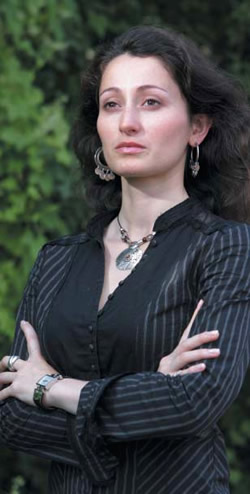
• Lira Tskhovrebova is the founder of the Association of South Ossetian Women for Democracy and Human Rights and has worked for more than a decade to improve relations between people of Georgian and Ossetian descent in the Caucasus.
* SECOND
Madina Gusalti is a journalist from South Ossetia who arrived in Barrhaven, Ontario, Canada on the afternoon of Fri., Aug. 8 to visit a classmate from university in Germany. Just hours before she arrived here, Georgian soldiers invaded her homeland, destroying homes and murdering innocent women, children and the elderly. Among the 2,000 slaughtered were her uncle and two cousins, killed by a Georgian soldier who found them and tossed a grenade into their hiding space. It is the third time that South Ossetia has faced an ethnic cleansing at the hands of the Georgian government, but it is a story that the western media has either ignored or denied. This is her story - a story of her people and their culture, their hope, their horrors, and the genocide that the world refuses to see.
I look at the moon every night, and I wonder. This moon that I look at every night while I am in Barrhaven is the same moon that my people in South Ossetia look at. Here, it is a beautiful moon, surrounded by stars. I see airplanes flying below it on their way to the Ottawa airport. But to the people in my homeland, this same moon is looked upon differently. It is a moon of fear. It is a moon that tells us it is night time - a time to be afraid of what may happen in the night. Ossetians do not have time to study the moon's beauty, but they wonder if they will see the moon tomorrow night.
Like there is another side of the moon, there is another side to the story that has been unreported by the western media. This is the story that 500 million Eastern Europeans know, but one that the media has kept away from Canadians and Americans. The story you have heard is that Russia invaded and occupies a sovereign nation. The truth is both far more simple, and far more complex. This is the story of my family and my land.
They died without reason in their beds, on the night of August 7. On the eve of the Beijing Olympics, while the world waited to celebrate the opening ceremonies in front of their television screens, the first of hundreds of artillery shells smashed through their ceilings, incinerating children and parents in their beds. They destroyed furniture, family photographs, heirlooms - everything that could burn, along with the overall sliver of security that the people believed they finally had. The shells rained down without warning. There was no time to escape or defend. By morning, 2,000 Ossetian people lay dead.
Two days earlier, these people sat in front of their televisions and watched the president of Georgia professing his love of South Ossetian people, promising them continued safety in the territory they reside. This message was supposed to be the commencement of peaceful negotiations between Georgia and South Ossetia regarding peace in the region. This message proved to be a deceptive ploy, a communiqué unobserved by western watchers, facilitating the surprise evening attack that left 2,000 South Ossetians dead.
The heavily-equipped Georgian army entered the town of Tshinvali, executing an operation that had been planned since 2006, code named "free field". The secret operation was uncovered in documents from a small group of Georgian soldiers, recently captured by Ossetian civilians. The military operation called for the quick and efficient destruction of all homes and their inhabitants; predominantly children, women and the elderly. My grandfather escaped the city the morning of August 8, awoken by the Russian Army who had entered the region to protect citizens, like my grandfather, from the invading Georgians. It was not an invasion by the Russians, it was a defensive action that was made in the nick of time. 'No people, no problem' was already the longstanding motto in Georgian politics, made famous by the most famous Georgian in history, Stalin. I am guessing these words are still relevant in Georgia. The Georgian military orders were clear - no one was to remain.
My grandfather was the lucky one. He survived. That same night of Aug. 7, I lost my uncle and both of his daughters - my cousins. They were murdered by Georgian soldiers in their home in the middle of the night, less than 24 hours after the Georgian President had promised peace.
In 1992, the parents of my uncle were murdered by soldiers in Georgia for no other reason than because they were South Ossetian. They were killed in their home. They were Ossetian by blood, but lived in Georgia in the home their family had owned and lived in for three generations. They were shot at point blank range, executed in front of their children and two grandchildren both under five years of age. They were all told, before the trigger was pulled, to watch closely, "This is what we do to Ossetians in Georgia".
Over the years, many of my family members have fled the South for the North. One evening in 1991, my aunt (my mother's sister) and her two daughters fled Georgia to North-Ossetia in the backseat of an old Ziguli brand car, hidden under potatoes, motionless, and barely able to breathe. The car was driven by an ethnic Georgian, who passed through numerous military checkpoints under the guise of transporting the produce to a distant market. The Georgian man risked his life for my family. He saved their lives.
During the war from 1989-92, South Ossetia lost almost half of its population. Thousands of people had to leave their homes and thousands of refugees travelled through the Caucasus Mountains to North Ossetia for refuge. Tshinvali, the capital of South Ossetia, still has not recovered. Even after 16 years, there remains no municipal water system and electricity is barely intermittent, coming from fuel powered generators. Food is available, however, unfortunately food exists for the same reason that the region was so easily attacked by the Georgian army two weeks ago - all the males are gone. Forced to leave for employment, they earn money as migrant workers in Russia and other CIS regions and send money and food back from North Ossetia.
I want you to know that the civilian people of Georgia don't want war. They are simple people, who in that sense are no different from the Ossetian people. I hold no grudge or hate toward them. I tell this story as I lived it. This is a war of politics and economics; a war of geography and egos. The people who are caught in the middle are the ones who suffer. When innocent people die, resentful people are born. This is why the conflict must be resolved while a few still remain on both sides who have still not been completely jaded by war. Peace must be built for both sides.
Three genocides have already been committed against the Ossetians by the Georgian government. Why does this remain unreported? Why hasn't the Ossetian story been heard?
The Russian army did not invade Georgia. They entered South Ossetia to force out the invading Georgians who were in the process of killing the remaining Ossetian people. If the Russian army had not arrived within 12 hours of Georgia entering South Ossetia, the 2,000 dead would clearly have been more, and the culture and people erased from the region forever. Later, the Georgian army admitted that they never anticipated the Russians to arrive so quickly, having estimated their undefended attack could last for days before any resistance would appear.
The population of South Ossetia is roughly 80,000. Obviously, a population of this size commands a very small audience on the world stage; therefore its voice is rarely heard. The territory is surrounded by Georgian land. The territory is not sovereign, nor does it form part of a supportive nation. It remains alone. The people hold no citizenship to their land. Over time, they have gradually been granted Russian passports even though the land is not Russian. Without these papers, they remain hostages to their land. Imagine living in a land where you can''t leave because, legally, your citizenship does not exist. Ninety percent of the South Ossetian people hold Russian passports, and as a result, Russia considers it their responsibility to defend these people against aggression, which is where this conflict stands.
It is a personal shame that the world hears only about my land in connection with conflict and war. It is a pity that in today's time of open international politics, with hundreds upon hundreds of international organizations, who are tasked to grapple with these issues, that truths still remain untold and voiceless people continue to suffer.
The world turns on its televisions, they see smoke, rubble, tanks and soldiers generally in barely identifiable military fatigues. The newscaster flashes unpronounceable names and cities, but the story is never completely explained. The connections and backgrounds behind the conflict and the people who have died, will die, and those who must carry their memory, are an afterthought.
It is a pity that in the time when the free press defends freedom, the truth and story of these people's lives still remains untold.
This is the picture of my land - South Ossetia - that you have come to learn. What I want you to remember is that the story of these people continues to be untold and, therefore, continues to suffer in the dark. The country's struggle has now been lost in the international political battle between Russia and Georgia, a battle which receives far more attention than the 80,000 voiceless souls who live within a territorial line that has become the background for the news stories you see and hear. For the last 80 years, South Ossetian people have lived for peace, freedom and autonomy. They have again paid a very high price for their hopes - they paid with the lives of their children, mothers and grandparents.
History of Ossetia
Ossetia is the country of the Ossetians and lies in the Caucasus, nestled between the Caspian and Black Seas. Today, the country is divided politically into two different areas, bordering on each other's regions and belonging to the different states. North Ossetia-Alania is a part of Russia, South Ossetia is an internationally-notapproved separate republic in Georgia. The Ossetians are descendants of Alans and the Sarmatian people, an old Iranian nomadic group which moved approximately 5,000 years ago from Persia in the Caucasus.
The culture of Ossetians is unique. The language of Ossetian is threatened with extinction and is, hence, a sign for the today's history and above all a unique spring for the linguists. South Ossetia has an old and unique culture, and it even has its own religion. The Georgian government wants to eradicate the culture and the language, refusing to allow the language into schools. People even have to change the spelling of their surnames to a Georgian name to get jobs. The South Ossetians are proud of their language and culture, and want to preserve it. They do not want to forget that King Arthur was a Scythian warrior, or that Alans left, everywhere in Europe, their tracks of sophisticated culture, inspiring scientists over and over again. This identity and culture is what the Ossetians have tried always to preserve.
Georgia-Ossetic conflict
At the end of the 20th century, the breakdown of the communist regime in Eastern Europe created several bloody and unforgotten ethnic conflicts, one of these remains the Georgian-Ossetian war.
The autonomous status of South Ossetia was granted in 1923 in the Georgian Socialist Soviet Republic. Near the end of the 1980s, Abkhazian and Ossetic nationalists started to seek more autonomy. The communist regime, particularly that of the Soviet Union, has consistently tried to manage and accommodate the national and ethnic differences between the people of region. Now free from communist doctrine, the Georgians, although having originally granted Ossetia autonomy, have continued to remove this right of free rule and cultural independence of the Ossentian people. This explains the surpression of the Ossetian culture and language, as explained above.
The Georgians brought instability into the territory in order to drive the people out of their land. They persecuted the Ossetians through looting, killing of cattle, burning of crops, and have instilled fear in the people through extortion.
From 1918-21, the first suppression of the Ossentian people began. It was at this time that Ossetia's national language was first forbidden. The only language to be spoken was Georgian. All Ossetian people were forced to change their names to Georgian names. The people became "guests" in their own land. The houses of Ossetian and Abkhazian people were burned. The Georgian army threw the small children, old people and pregnant women off of cliffs, which are plentiful in this mountainous region. They burned thousands of towns and villages and, within days, 5,500 people were killed. After three weeks, the first purge of South Ossetia left the territory nearly bare. It was at this moment that South Ossetia was granted autonomy in Georgia.
Currently, the Georgian government continues to call itself a democratic sovereign nation, safe for its people and neighbours. Georgia does not call its actions genocide, they call it war. But a war is between two armies, not between an army and a nation of women, children and the elderly, who are killed in their sleep. There are very few men in South Ossetia, as most are away working in Russia.
For several decades, the South Ossetian government has tried to achieve the status of a sovereign state. I, and my people, want no war. We want to live with our neighbours in peace. We want a state where there is no fear of repercussion; where we can live proudly in a country that allows its people to have its history and culture. Never again do we want tears. Never again do we want grief. There is a new hope for peace and freedom, but it is a pity that so many people had to die for this dream.
It's difficult for some people to understand what our people are going through and how we feel. Canada is beautiful, and everybody in your community has been wonderful to me. Canadians are a lot like Ossetians. Our countries are beautiful and our people are friendly. The people I have met are proud to be Canadian, just as we are proud to be Ossetian.
In Canada, however, people can stop and enjoy the beauty of their country. In Ossetia, there is no time to enjoy the beauty of the land. We stay home, and when we go out, we are afraid. We cannot stop to see how beautiful our country is. We just do what we have to do, and then we go home as quickly as possible. The people are angry and upset and afraid. They don't know what the next day will bring. Ossetians are, culturally, a very loud and happy people. In the evening we would celebrate life. There would be guitars being played on the streets and people would be happy and dancing and having fun.
But the biggest difference that I see is with children. In Canada, the children laugh and play and smile. They even cry. In Ossetia, we have a generation of children who cannot be children. They may not understand politics, but they know fear. I want that to stop. I want the children - both Ossetian and Georgian - to have peace and to have hope. More than anything, I want the children to have the same childhood that I had in Ossetia. I want them to laugh and to cry and to smile and to dance. I want them to be children. But that is a dream. Right now, a bigger issue is that women are afraid to even have families. What kind of violent world would we be bringing children into?
And at night, I want them to look up and see the moon, and I want them to feel what I am feeling when I look at it here in Barrhaven.
Madina Gusalti is currently completing her PhD in Politics and Languages at the University of Hamburg, Germany. She is an active member of the NGO, nonpolitical group that promotes cultural understanding within the Caucasus region, as well as the Ossetic and Georgian Diaspora "Alanis".
* THIRD
version 29 August, 2008, 14:28
It hasn't rained in Tskhinval for almost a month. The dust left behind by the bombardment still hangs over the city. And the imprints of blood haven't been washed away. Like the heavens above, some South Ossetian women can no longer cry. So much has been taken from them that even tears, the natural mechanism for coping with grief, have dried up. Tskhinval is now a city burning with anguish. A city of desolate mothers.
Parents are not supposed to bury their children. But Taisia is laying a son to rest for the second time. Even in a city soaked in grief her story is heartbreaking.
“Show this to Georgian mothers. Why did they let their sons come here? Why did they let them kill my boy? What have I done to you?” Taisia Sytnik asks.
Taisia's son Georgy was her biggest source of pride. Young and handsome, he had just finished medical school and found a job at a dental clinic in Moscow. Last month Taisia bought him a medical outfit.
“Look at what I brought to you…I wanted you to be the most handsome (man) in Moscow…” Taisia says.
When Georgy heard Tskhinval was under attack, he rushed home – to help the injured. On August 9, he stepped out of the basement to get some bandages when a piece of shrapnel hit him.
Georgy died instantly. But the suffering his mother would have to endure had just begun. For the next three days, she remained trapped in the basement with her son's body lying next to her.
Surrounded by women and children she couldn't even cry. Meanwhile, death was slowly taking over the body of her dear boy.
Like Georgy, hundreds of Tskhinval residents were crushed by GRAD (or Hail), multi-rocket launch systems given the nickname from the atmospheric phenomenon. Indiscriminate and plentiful, these killing machines beat Tskhinval to a pulp.
“They were killed by GRAD. A mother and daughter. It was definitely GRAD because it tore off the mother's head. And the daughter – she doesn't have a leg,” a local said.
The Georgian rockets didn't just kill. They also mutilated their victims beyond recognition. Vyacheslav Mami has worked at Tskhinval's morgue for more than 30 years but he had never seen such badly disfigured bodies before.
“The only way you could identify most of the bodies is by their clothes or some documents. The mutilation was so extensive and so multiple that when my own colleagues received them, I didn't recognise them,” says Vyacheslav Mami, Director of Tskhinval morgue.
But as hundreds were being killed, this little boy decided to make his appearance in the world. His mother Shurena was taken to hospital on the eve of the Georgian assault. She went into labour hours after the bombardment began.
“The heavy shelling was non-stop. Our hands were shaking but we still were able to deliver this baby boy. Praise God that he's kept us all safe. You know you can't completely annihilate the Ossetians,” says Ira Kuzaeyeva, a nurse.
Shurena is still so traumatised she can hardly speak. She is still too frail to leave the basement where her son was born and her family doesn't know where she is.
“I still don't know what happened to my family. My husband went to fight. Thank God my baby is ok,” says Shurena Kachmazova, a young mother.
Shurena told us she comes from a small village on the border with Georgia. And as we were going to visit the area, we decided to find her parents.
When we reached Shurena's village, it appeared to be completely deserted. The women and children had left, only the men stayed behind. Shurena's father was at home. When we told him he had a grandson, he broke down in tears.
“My daughter left days before the bombardment and since then we haven't heard a word about her. We prayed for her to stay alive. Her mother went to Tskhinval to look for her,” says Nudar Kachmazov, Shurena's father.
This is their first grandchild and the family has long anticipated his arrival. Shurena's father made this traditional South Ossetian cradle. And he has already chosen a name.
“I want him to be named Geimurat. I want him to become a good man,” Nudar Kachmazov says.
But such family reunions are rare. The war caught many people off guard, allowing some to flee and trapping others in their basements. Tearing families apart, forcing mothers to fear the worst.
“My son is there, my daughter is also in Tskhinval. I don't know what will happen to them. I just don't know what to do,” a local said.
Having fled the bombardment, these mothers couldn't escape the desperation of not knowing whether their children were still alive. When the French Foreign Minister came to visit a refugee camp in Russia, the hopeless women just wouldn't let him go. “They don't spare anyone… Innocent people die… Please help us…. Please help us if you can… Please help our boys… Please…” women were saying.
Meanwhile, what was happening in Tskhinval was worse than anybody could have imagined. Death in its ugliest form was striding over the city, leaving rotting bodies on the pavements.
A large family used to live in a house, now ruined. Two of them – a young woman and her 5-year-old son managed to escape – while the grandparents and a teenage boy stayed behind. The traces of blood map out their last movements. The three were buried in their own yard, among the corn stems and tomato plants. “The neighbours couldn't drive them to the cemetery because the fighting was still on. But neither could they leave the bodies out here. It's a matter of honour for South Ossetians. You have to bury the dead,” says Konstantin Tebilov, Tskhinval resident.
Taisia was also forced to bury her son in the garden. When the barrage subsided, she wrapped his body in linen and with the help of neighbours, carried him to a place where, as a boy, Georgy used to play hide-and-seek with his younger sister. She is now 18 and the only reason for her mother to carry on.
“They will have to go on – for the sake of their daughter. Her entire future is now at stake…” said Alan Parostayev, a relative.
Days after the bombardment ended, Taisia and her relatives exhumed Georgy's body to give him a proper funeral. As his coffin was lowered into the grave, two more families arrived at the cemetery to bury their sons. Unacquainted before, these mothers are now bonded by their black veils.
In South Ossetia, when somebody dies, the immediate family is usually spared the grim task of arranging the final ceremony. Relatives and friends normally take care of everything. But with so many having been killed, the actual funerals themselves have become something of a torture.
In the first days of war, coffins were in short supply. “We didn't have enough coffins. The electricity was off and all the workshops were closed. Than, a few days later, a batch of coffins arrived from Vladikavkaz as humanitarian aid,” said Vyacheslav Mami, director of Tskhinval morgue. Out of 300 coffins, only eight are still remaining.
But as the dead are laid to rest, the survivors live to fight another day. Even after the fighting had ended, Tskhinval hospitals reported a steep rise in the number of patients suffering and dying from heart attacks. This pharmacy, which didn't close even during the assault, is now almost completely out of stock. While medicine is being distributed free of charge, pharmacy staff are trying to keep track of who needs what. “We're keeping this journal for accounting purposes. We are required to ask our customers about their home address and this simple question brings some people to the brink of hysteria. What home, they say… Everything has been burned…” said Zhuzhena Abayeva, the pharmacy director. One young mother came to get some painkillers. Her migraines just won't go away, she says. And her baby has become restless. It's no longer war, but peace is still very far away.
Concert
A deafening silence followed by the throng of heavy artillery: this was how the war came to South Ossetia. Throwing people out of their beds and off the course of normal life.
For Valery Gergiev, one of Russia's most renowned conductors, this concert was his way of saying goodbye to the old Tskhinval. Vibrant and colourful as it was just a month ago, the city now smells of decomposing human flesh.
“I'm an Ossetian myself and I came here with the world famous Mariinsky Theatre to Tskhinval to see the horrible destruction of this city. It was a huge act of aggression on the part of the Georgian army but it is not yet a known story to the world,” said Valery Gergiev, Mariinsky Theatre artistic director.
Some of the audience later compared this concert to a long awaited communion. For several days after the bombardment, Tskhinval was left without religious services.
When the violence subsided, we found the province's head priest walking around the town to check what was left of his once large flock. «60 per cent of my parishioners were killed, annihilated. They particularly tried to target churches because they knew people were hiding there,» said Father Georgy, Bishop of South Ossetia. Even priests found it hard to preach forgiveness in Tskhinval. With so many killed, the animosity is still fierce.
It was Georgian soldiers who killed Evelina's son. It happened 16 years ago during the first round of clashes between Georgia and South Ossetia. Over the past few weeks, Evelina, a nurse at one of Tskhinval's hospitals, had to relive her loss over and over again. “During the bombardment, many of the injured we received were 20 to 21-year-old boys. They were so young – like my son when he was killed,” said Evelina Kokoeva, Tskhinval resident. The cemetery where Evelina's son is buried was also damaged during the assault. Even the dead weren't spared.
The traditional view that men fight in wars and women suffer the losses no longer holds true. According to South Ossetian officials, female soldiers, including snipers, fought on the Georgian side. And on the Russian side, too, the number of female troops was higher than in any other conflict.
Meet Katya. 25 years old. Single. A junior sergeant. She entered the Russian army six years ago to continue the family tradition and to escape unemployment in her home city of Vladikavkaz. “My parents were a bit concerned about me going to war…” she said. Her battlefield is this makeshift bakery where she spends more than twelve hours a day. With her unit stationed deep in the rear, Katya hasn't seen much of the fighting. Yet the vintage decor of the room she's sharing with her fellow soldiers serves as a reminder of how this conflict began.
Joseph Stalin was one of the first leaders to proclaim South Ossetia part of Georgia. Himself half Georgian, half Ossetian, Stalin didn't have any qualms about changing the administrative borders. During the Soviet period, both Georgia and South Ossetia were part of a much larger country.
Back then, Milena Razmadze was teaching geography at a high school. In her photo album, the Georgian and Ossetian students seem blissfully unaware of each other's ethnicity. This issue only came up in the early 1990s when Zviad Gamsakhurdia came to power in Georgia. “Gamsakhurdia was saying all the time that Georgia was for Georgians. I remember one day I came to my class and asked how could this be? There was a Georgian boy sharing a desk with an Ossetian girl. Should we kill one of them?” said Milena Razmadze, Tskhinval resident.
Born in Georgia, Milena moved to Tskhinval more than 50 years ago after marrying a South Ossetian. “We got divorced but I never thought about leaving Tskhinval. This is my home,” said Milena Razmadze.
But after the Georgian incursion, thousands of ethnic Georgians who lived in South Ossetia prior to the conflict had to flee their homes fearing reprisals from their South Ossetian neighbours. Before the violence broke out, this village – about 15 kilometres from Tskhinval – was populated mainly by ethnic Georgians. You cannot find a single soul here anymore and most of the houses were set on fire. The Georgians fled in a hurry, leaving behind most of their belongings. Some even abandoned their elderly parents. When Russian emergency workers entered this village they didn't find a single person under 60. With hundreds killed and the city of Tskhinval in ruins, no wonder tolerance is in short supply.
This mother whose son was killed by Georgian troops says there can be no reconciliation. “Their blood is poisoned, I tell you, it is. Today they are peaceful, tomorrow they could slaughter us all,” said Ada Kokoeva, Tskhinval resident.
Two Georgian families still live in this apartment block. During the bombardment they were hiding in the basement together with South Ossetians. But the neighbours no longer talk to each other. “What concerns us, our relations with the Georgians didn't change… But they are somehow estranged from us,” said Ada Tebilova, Tskhinval resident. We tried to speak to these Georgian families but nobody answered the door. According to some estimates, prior to this conflict, ethnic Georgians made up a third of South Ossetia's population. When the fighting began many fled to Georgia. Except for Milena Razmadze.
“How could I flee? My sons would have been in danger then,” said Milena Razmadze. Milena says she never felt threatened because of her ethnicity. The only time she feared for her life was during the bombardment when she was hiding in this bunker with her 5-year-old grandson. “He was so frightened he started to cry: ”Grandma, the Georgians will come and kill us!“ I answered: ”I am Georgian, can you imagine that I would kill you? Don't be scared," Milena says.
But the fear of Georgians still remains, even among adults. Posters like this one are plastered all over the town warning residents against buying Georgian goods. It says even barrels of wine may contain explosives. Dozens of ethnic Georgians remain in captivity in South Ossetia. Most of them are believed to be farmers from neighbouring villages who were detained for questioning and are now in limbo.
According to South Ossetian officials, there are about 200 Georgian POWs in Tskhinval, most of them are believed to be civilians. In Tskhinval officials say they are ready to hand them over to Georgia but Tbilisi is not in a hurry to file an official request.
And when a state fails, people are prepared to take justice into their own hands. Unlike the farmers sweeping Tskhinval's streets, these two men came to South Ossetia armed with the weapons. They were captured with their tank in the midst of Georgian assault. “All we want now is to get back home alive. And to see our families and friends,” they said. Both signed a contract with the Georgian army less than two years ago. And both are now blaming the Georgian leadership for what has happened. “We didn't expect that we'd have to come here. We are just common soldiers, we did what we were ordered to do,” they said. These prisoners say they never aimed their guns at civilians, but the state of neighbouring villages suggests otherwise.
A Georgian artillery unit these prisoners belonged to was stationed in front of a 15th century church. Some of the traces of the Georgian presence still remain. Georgian troops stayed for two days firing at the village from underneath the crosses. Empty ammunition boxes and some of their weaponry are still scattered across the area. The villagers didn't dare to shoot back at the old church.
“They put a tank here at the top of the hill and started shooting in all directions, at all the buildings,” a local says. In a local school, some of the classrooms don’t exist any more. Students' books litter the football field. Most of the residents have fled or died. “So many people were killed we don't have enough land to bury them. Two of our people were taken prisoner,” a local says. The villagers are now hoping for a prisoner exchange.
The commander of a South Ossetian unit holding Georgian POWs says the negotiations are ongoing. But despite their bruises and the uncertainty, these Georgian prisoners are still lucky. The fields around Tskhinval are now filled with the bodies of their dead comrades.
One valley became the point of no return for many Georgian soldiers. “Our people made coffins for the Georgian dead. They are now ready to be shipped to Georgia. No matter what happens we're Christians and the dead have to be buried in a good, traditional way,” a South Ossetian military man said. Yet this is what many of the victims of this conflict were denied. Mutilated and burned beyond recognition, dozens of bodies went missing. Among them not only soldiers, but also journalists.
No parent would wish to be present at their child's funeral but lately for Yulia Klimchuk it was the only thing she was praying for. Her son Aleksandr was killed in South Ossetia and if it wasn't for his colleagues in Russia, this Georgian family might never have recovered his body. Aleksandr was a photographer for the Russian news agency ITAR-TASS.
Based in the Georgian capital Tbilisi, he often covered tensions between Georgia and its breakaway republics. When the war began, Aleksandr and his colleague Grigo Chekhladze traced Georgian forces in South Ossetia. Nobody knows for sure what happened next. “The doctors couldn't tell me the cause of death. I was only told that their bodies had been picked up by Russian troops and delivered to this Tskhinval morgue,” said Sergey Uzakov, ITAR-TASS photographer. He was the one who identified the bodies and the one who promised Yulia she would have the chance to bury her son. Together with colleagues, he somehow found these two metal boxes and drove them across the border into Georgia. “Other journalists have joined us here. Our friends from AP, Reuters, France Press, Time are here today. We all see it as our duty to complete this,” said Sergey.
At least three journalists were killed and more than ten injured in this brief war. But when it seemed like there was nothing more to report than death and suffering, we found Nino. Like most people in Tskhinval, she was in pain. Excruciating and almost unbearable pain, but one that will soon be forgotten. 50 centimetres and 2.8 kilogrammes. A bundle of new life in a city stricken by grief. A reward for everything her parents had to go through. “We were at home, it's located deep in the gorge, thank God, the Georgians didn't reach us! But we were really worried…” said Albert Tuvaev, the girl’s father. For Nino, It's her first child. And she has already chosen a name. “I want to call her Maria or Marianna,” Nino says. According to an ancient South Ossetian belief, when many boys are born, war is just around the corner. But this child – the first to be born after the end of hostilities – is a girl. It’s hoped that this means peace will return to South Ossetia.